Nostalgia
Old-Time Radio Word Search (Large Print)
For adults and seniors · letters 22–28 pt in the PDF · answer key on page 2 · free to copy for classroom, library and senior-center use.
Before a picture appeared on a screen, a voice and a sound effect could suggest an entire room. This old-time radio word search explores listening equipment and the work of making a broadcast. The entries include drama, comedy, news, and studio tools, so it can interest people who remember cabinet radios and those who have only seen them in photographs.
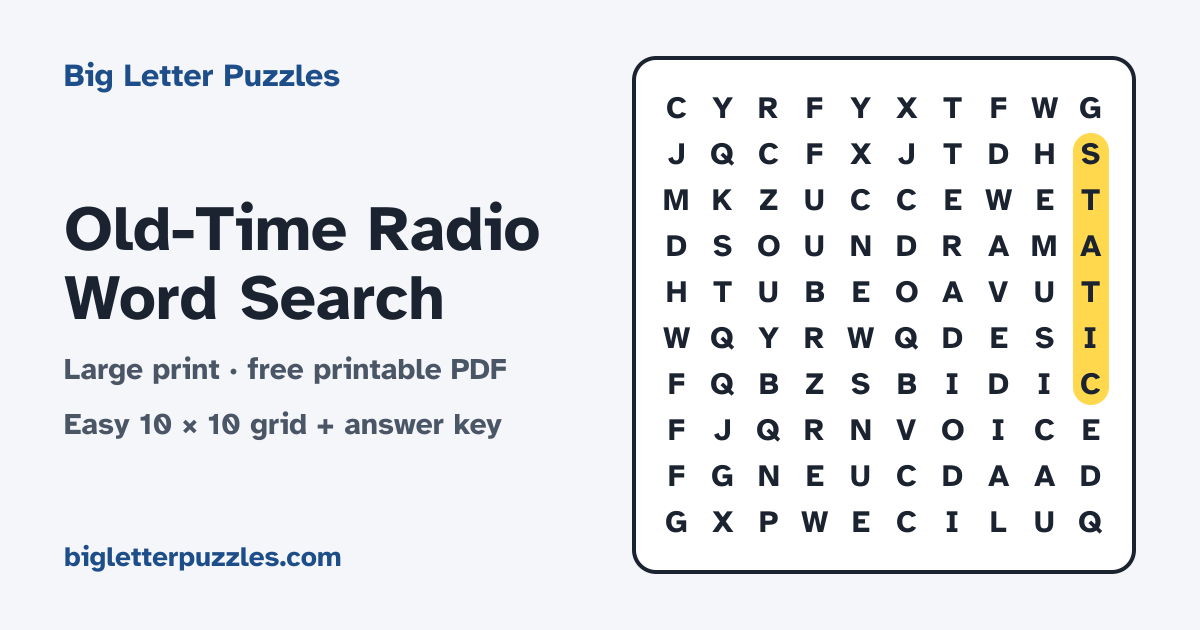
Old-Time Radio Word Search: Easy
10 × 10 grid. Find 10 words. Look across to the right and down.
Words to find
- DIAL
- DRAMA
- MUSIC
- NEWS
- RADIO
- SOUND
- STATIC
- TUBE
- VOICE
- WAVE
US Letter, one puzzle page and one answer page. Easy level.
Old-Time Radio Word Search: Medium
12 × 12 grid. Find 15 words. Look right, down, and diagonally downward.
Words to find
- AERIAL
- COMEDY
- DIAL
- DRAMA
- MUSIC
- NEWS
- RADIO
- SCRIPT
- SERIAL
- SIGNAL
- SOUND
- STATIC
- TUBE
- VOICE
- WAVE
US Letter, one puzzle page and one answer page. Medium level.
Old-Time Radio Word Search: Hard
14 × 14 grid. Find 20 words in all eight directions, including backward.
Words to find
- AERIAL
- CABINET
- COMEDY
- DIAL
- DRAMA
- MUSIC
- NEWS
- RADIO
- SCRIPT
- SERIAL
- SIGNAL
- SOUND
- SPEAKER
- STATIC
- STUDIO
- TUBE
- TUNING
- VOICE
- VOLUME
- WAVE
US Letter, one puzzle page and one answer page. Hard level.
Playing tips and a fun fact
Begin with a word you can picture, such as DIAL or SPEAKER. Longer entries like CABINET are easier to check when you follow each letter with a fingertip before circling. A group might read a brief invented announcement aloud, then search for the equipment that would help send it to listeners.
Radio drama often uses carefully made sound effects to suggest footsteps, doors, or weather. A sheet of paper and a few taps on a table can inspire a tiny demonstration without any recording equipment. After the puzzle, create a two-line fictional weather report or describe the appearance of an imaginary radio cabinet, keeping the activity playful and voluntary.
Ideas to extend the activity
- Invent a two-line radio announcement.
- Make a gentle paper sound effect.
- Draw a radio cabinet and dial.
Not sure which level to pick? Read how the easy, medium and hard levels differ, or see how to print large-print puzzles so the letters come out dark and clear.
About the words in this puzzle
- KDKA in Pittsburgh broadcast the 1920 presidential election returns, an event widely recognized as the start of commercial radio in the United States. RADIO is an easy word.
- Daytime serial dramas were nicknamed soap operas because soap companies sponsored many of them. SERIAL is a medium-level word.
- Radios used glass vacuum tubes until the transistor, invented at Bell Labs in 1947, made smaller sets possible. TUBE is an easy word.
- President Franklin Roosevelt began his radio “fireside chats” in 1933 to speak directly to listeners at home. NEWS and VOICE are both easy words.
Tips for this theme
- Read the word list aloud in your best announcer voice. A little theater breaks the ice and suits the theme, and you can skip it if the room prefers quiet.
- Let people who grew up with a family radio explain DIAL and TUNING to those who did not. One minute per word is plenty.
Sharing this with a group? Read Plan a Welcoming Puzzle Hour for Groups. Want words from your own memories? Read How to Make a Word Search Puzzle: Step-by-Step Guide.
Questions about this puzzle
What is the difference between AERIAL and SIGNAL?
An aerial is the wire or rod that catches radio waves, and a signal is what it carries. Both are medium-level words, so a solver finds them at the same time. The easy level has WAVE and STATIC for the same family of ideas, which makes a good small vocabulary set.
Which radio words appear only at the hard level?
CABINET, SPEAKER, STUDIO, TUNING and VOLUME. CABINET and SPEAKER are the longest at seven letters. STUDIO and TUNING share the letters T, U and I, so check the full spelling before circling and read each line in both directions in the 14 by 14 grid.
Can I pair the puzzle with an old broadcast?
Yes. Play a short audio drama or news segment at low volume while solvers work, and ask them to circle any grid word they hear. Choose a recording you have the right to play, such as one from a library collection, and keep the volume low enough for the table to talk.
More word searches you might like
Browse all 79 word search themes · Make a word search with your own words · Large print Sudoku · Printable mazes