Hobbies & places
Music & Instruments Word Search (Large Print)
For adults and seniors · letters 22–28 pt in the PDF · answer key on page 2 · free to copy for classroom, library and senior-center use.
Strings, keys, reeds, and a steady beat come together in this music word search. The list includes familiar instruments and a few words for the sounds they make. It is a useful choice for a music afternoon, but the room can stay quiet while people solve. No ability to read notation, identify a tune, or play an instrument is needed.
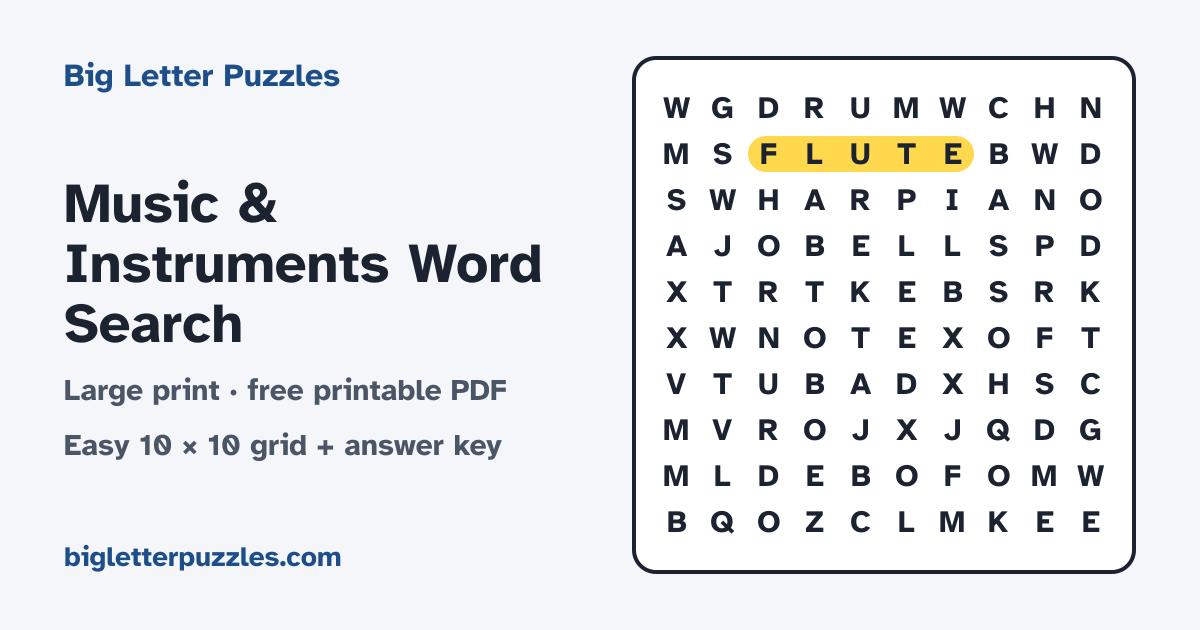
Music & Instruments Word Search: Easy
10 × 10 grid. Find 10 words. Look across to the right and down.
Words to find
- BASS
- BELL
- DRUM
- FLUTE
- HARP
- HORN
- NOTE
- OBOE
- PIANO
- TUBA
US Letter, one puzzle page and one answer page. Easy level.
Music & Instruments Word Search: Medium
12 × 12 grid. Find 15 words. Look right, down, and diagonally downward.
Words to find
- BANJO
- BASS
- BELL
- CELLO
- CHORD
- DRUM
- FLUTE
- HARP
- HORN
- NOTE
- OBOE
- ORGAN
- PIANO
- TUBA
- VIOLA
US Letter, one puzzle page and one answer page. Medium level.
Music & Instruments Word Search: Hard
14 × 14 grid. Find 20 words in all eight directions, including backward.
Words to find
- BANJO
- BASS
- BELL
- CELLO
- CHORD
- CYMBAL
- DRUM
- FLUTE
- GUITAR
- HARP
- HORN
- MELODY
- NOTE
- OBOE
- ORGAN
- PIANO
- TEMPO
- TUBA
- VIOLA
- VIOLIN
US Letter, one puzzle page and one answer page. Hard level.
Playing tips and a fun fact
Begin with an instrument you can picture clearly. HARP and DRUM have very different shapes, which can help you keep their words distinct while searching. Some names share letters, so check the whole entry rather than circling a promising fragment. In a group, let participants point to an imagined instrument or describe its sound in their own words.
A piano makes sound when small hammers strike strings, connecting its keyboard to a less visible part inside the case. That offers a conversation about how instruments produce sound. After the search, draw a tiny imaginary band or arrange the found instruments into strings, winds, and percussion, allowing a little discussion about instruments that cross categories.
Ideas to extend the activity
- Draw an imaginary four-piece band.
- Sort instruments by how sound is made.
- Tap an optional gentle rhythm.
Not sure which level to pick? Read how the easy, medium and hard levels differ, or see how to print large-print puzzles so the letters come out dark and clear.
About the words in this puzzle
- The piano was invented around 1700 by Bartolomeo Cristofori in Italy. Its full name, pianoforte, means “soft-loud,” because it could play both quietly and loudly. PIANO is an easy word.
- The banjo grew out of lute-like instruments of West Africa, and enslaved Africans in the Americas built the first banjos from that tradition. BANJO is a medium-level word.
- Some of the oldest known musical instruments are flutes made from bird bone and mammoth ivory, found in caves in southwestern Germany and estimated to be 35,000 to 43,000 years old. FLUTE is an easy word.
- A pipe ORGAN makes sound by pushing air through pipes of different lengths, and longer pipes give lower notes.
Tips for this theme
- VIOLA and VIOLIN begin with the same four letters, so confirm the ending before circling either one.
- Ask any musician at the table which of the words they would most like to describe, and let them do it in their own words or with a gesture. The page is quiet, but the conversation can be lively.
Looking for a faster way through the grid? Read How to Find Words in a Word Search: Strategies That Work. Want to add your own club or trip words? Read How to Make a Word Search Puzzle: Step-by-Step Guide.
Questions about this puzzle
Why are VIOLA and VIOLIN both in the puzzle?
They are different instruments: the viola is slightly larger than the violin and tuned lower. VIOLA is a medium-level word and VIOLIN a hard-level one, so a solver meets them one level apart. Check the last letters before circling, since both begin with the same four.
Which instruments are in the easy puzzle?
BASS, BELL, DRUM, FLUTE, HARP, HORN, OBOE, PIANO and TUBA, plus the word NOTE. That is nine instruments from the string, wind, brass and percussion families in a 10 by 10 grid, so even the first level covers several kinds of sound.
Do I need to read music?
No. NOTE, CHORD, MELODY and TEMPO are everyday music words, and the puzzle only asks you to find their spelling. The word list is printed beside the grid, so anyone can solve it regardless of musical background, and a musician can add context if they wish.
More word searches you might like
Browse all 79 word search themes · Make a word search with your own words · Large print Sudoku · Printable mazes