Food & home
Fruit Word Search (Large Print)
For adults and seniors · letters 22–28 pt in the PDF · answer key on page 2 · free to copy for classroom, library and senior-center use.
A bowl of fruit offers a bright theme for a puzzle that uses only ink and paper. This word search moves from short names such as FIG and PEAR to longer market favorites. It suits a picnic table, a food-themed activity hour, or a quiet break while planning groceries. The words are written without spaces, so each entry follows one straight line through the grid.
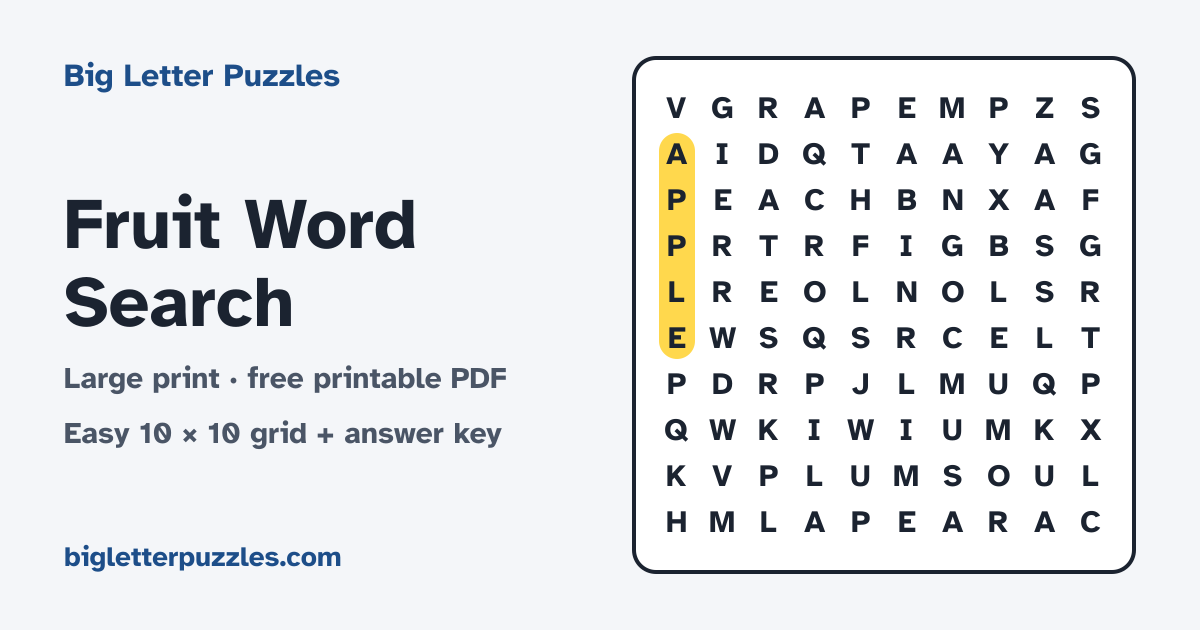
Fruit Word Search: Easy
10 × 10 grid. Find 10 words. Look across to the right and down.
Words to find
- APPLE
- DATE
- FIG
- GRAPE
- KIWI
- LIME
- MANGO
- PEACH
- PEAR
- PLUM
US Letter, one puzzle page and one answer page. Easy level.
Fruit Word Search: Medium
12 × 12 grid. Find 15 words. Look right, down, and diagonally downward.
Words to find
- APPLE
- BANANA
- DATE
- FIG
- GRAPE
- GUAVA
- KIWI
- LEMON
- LIME
- MANGO
- MELON
- ORANGE
- PEACH
- PEAR
- PLUM
US Letter, one puzzle page and one answer page. Medium level.
Fruit Word Search: Hard
14 × 14 grid. Find 20 words in all eight directions, including backward.
Words to find
- APPLE
- APRICOT
- BANANA
- CHERRY
- COCONUT
- DATE
- FIG
- GRAPE
- GUAVA
- KIWI
- LEMON
- LIME
- MANGO
- MELON
- ORANGE
- PAPAYA
- PEACH
- PEAR
- PINEAPPLE
- PLUM
US Letter, one puzzle page and one answer page. Hard level.
Playing tips and a fun fact
Try choosing a fruit by its imagined color before searching for its letters. Several names begin differently but end in similar ways, so read the entire word when you think you have found it. With a partner, take turns describing a fruit without saying its name, then locate the matching entry together.
A pineapple develops from many small flowers whose fruits join into one structure. Its rough outer pattern is quite different from the smooth skin of a plum. After the search, draw a mixed fruit bowl or arrange the listed fruits into an imaginary market display, using shape rather than price to decide where each belongs.
Ideas to extend the activity
- Draw a mixed fruit bowl.
- Describe a fruit without naming it.
- Plan a colorful picnic fruit plate.
Not sure which level to pick? Read how the easy, medium and hard levels differ, or see how to print large-print puzzles so the letters come out dark and clear.
About the words in this puzzle
- The color orange was named after the fruit, not the other way around. English speakers began using orange as a color name in the early 1500s, after the fruit became known in Europe. ORANGE is a medium-level word.
- A banana plant is not a tree. Its trunk-like stem is made of tightly overlapping leaf bases, and botanists classify the plant as a giant herb. BANANA is a medium-level word.
- Kiwifruit is named after New Zealand's kiwi bird, but the fruit has its roots in China, where it was once called Chinese gooseberry. KIWI is an easy word.
- PEACH, PLUM, CHERRY and APRICOT are all stone fruits: each holds a single hard pit around a seed.
Tips for this theme
- Bring a few real pieces of fruit for a tasting break after the search. Check for allergies before you pass anything around.
- Start the hard grid with PINEAPPLE. At nine letters it covers most of a row, so scanning for its first three letters in any line is a quick way to find it.
- Let the word list double as a shopping list. Ask each person to circle two fruits they would put in a bowl for the table.
Have your own recipes or family names in mind? Read How to Make a Word Search Puzzle: Step-by-Step Guide. Collecting favorites for a gift? Read Make a Printable Puzzle Booklet as a Gift.
Questions about this puzzle
How long is the longest word in the Fruits puzzle?
PINEAPPLE, at nine letters, is the longest hard-level word, followed by COCONUT and APRICOT at seven. The easy level's longest words are APPLE, GRAPE, PEACH and MANGO, at five letters. A long word covers more than half of a 14-letter row, so scanning near the edges is a good place to start.
Can I use this with children learning fruit names?
Yes. The easy level has ten fruits that most children know by sight, such as APPLE, GRAPE, PEAR and PLUM, in a 10 by 10 grid where words only run right or down. Bring a real fruit or two to hold up as each word is found, and let children read the word list aloud.
Which fruits in the puzzle grow in warm climates?
MANGO, GUAVA, PAPAYA, BANANA, COCONUT and PINEAPPLE are tropical or subtropical fruits, while APPLE, PEAR, CHERRY and PLUM prefer cooler places. Sorting the words by climate after the search is an easy conversation starter, and it shows how far a fruit bowl can travel.
More word searches you might like
Browse all 79 word search themes · Make a word search with your own words · Large print Sudoku · Printable mazes